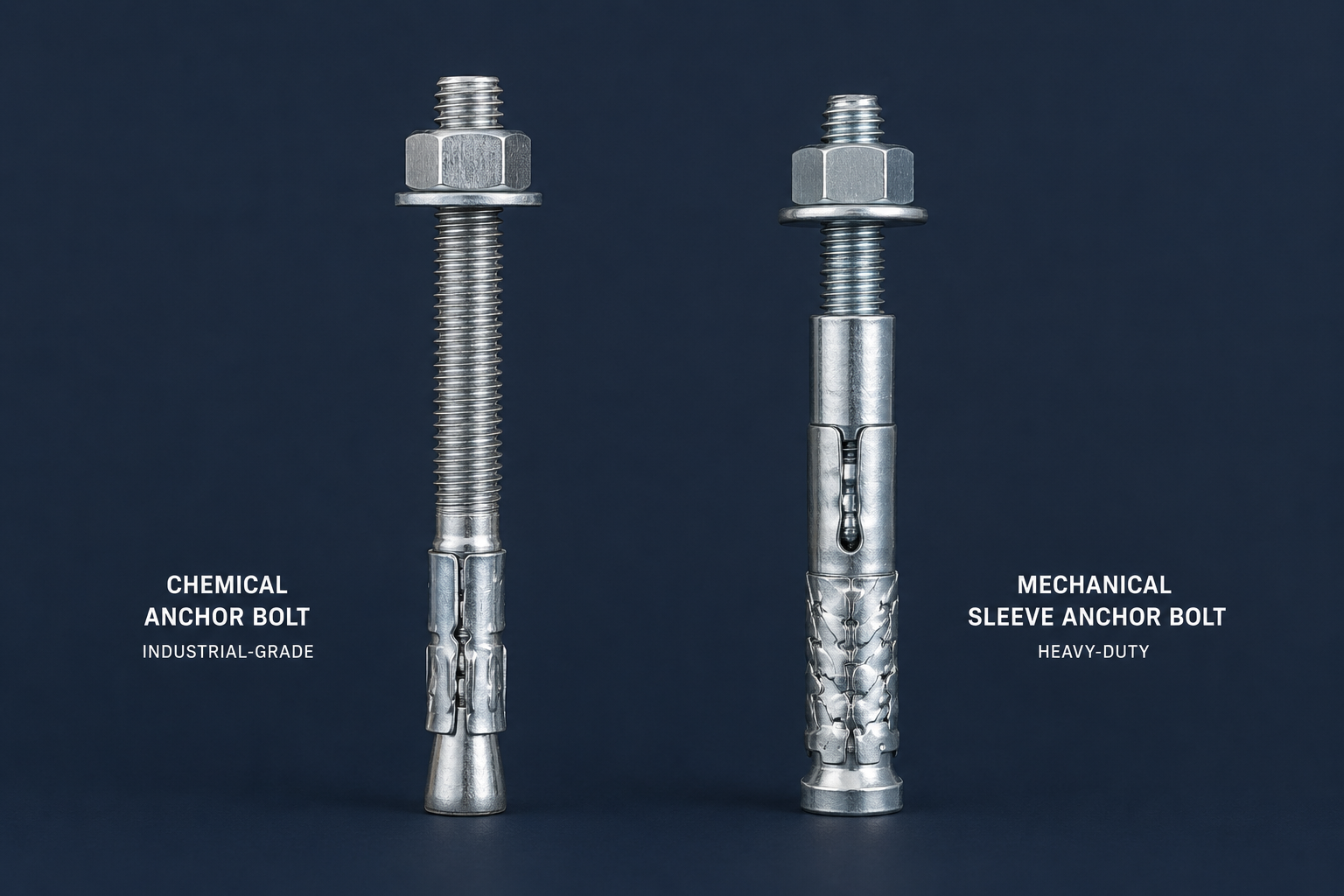
Introduction
Selecting the right concrete anchors is one of the most important decisions in any construction or structural installation project. Whether you’re installing heavy machinery, structural steel, handrails, shelving systems, or façade components, the anchor you choose directly affects the strength, safety, and longevity of the installation.
Among the most widely used concrete anchors types, two categories dominate the market: mechanical anchors and chemical anchors. Each offers unique advantages depending on the application, load requirements, and environmental conditions.
In this guide, we’ll compare chemical anchoring vs mechanical anchoring to help engineers, contractors, and builders select the most suitable solution for their projects.
What Are Mechanical Anchors?
Mechanical anchors create a secure connection by expanding or gripping against the concrete after installation. They provide immediate holding power without requiring curing time, making them ideal for fast-paced construction projects.
Common Types of Mechanical Anchors
Sleeve Anchors
Sleeve anchors are versatile fasteners suitable for medium-duty applications. They perform well in concrete, brick, and masonry, making them a popular choice for installing brackets, railings, electrical fixtures, and light structural components.
Wedge Anchors
Wedge anchors are designed for heavy-duty fastening in solid concrete. As the nut is tightened, the clip expands against the concrete, creating exceptional holding strength for structural steel, machinery, and industrial equipment.
Advantages of Mechanical Anchors
-
Immediate load-bearing capability
-
Quick and simple installation
-
Cost-effective solution
-
Reliable for standard construction applications
-
Ideal for repetitive installations
Best Applications
-
Steel structures
-
Equipment installation
-
Safety barriers
-
Cable trays
-
Pipe supports
-
Industrial shelving
What Are Chemical Anchors?
Chemical anchors, also known as bonded or resin anchors, use high-performance epoxy, polyester, or vinyl ester resins to bond threaded rods or reinforcing bars directly into concrete.
Unlike mechanical anchors, chemical anchors do not rely on expansion pressure. Instead, the adhesive forms a powerful bond with both the concrete and the anchor, distributing loads evenly throughout the substrate.
How Chemical Anchors Work
The installation process involves:
-
Drilling the hole
-
Cleaning the hole thoroughly
-
Injecting chemical resin
-
Inserting the threaded rod or rebar
-
Allowing the resin to cure before applying the load
Advantages of Chemical Anchors
-
Extremely high load capacity
-
No expansion stress on concrete
-
Suitable near edges and corners
-
Excellent performance in cracked concrete
-
Superior corrosion resistance
-
Ideal for seismic and heavy structural applications
Best Applications
-
Structural steel connections
-
Bridge construction
-
Reinforcement bar installation
-
Heavy machinery foundations
-
High-rise buildings
-
Infrastructure projects
Chemical Anchoring vs Mechanical Anchoring
Choosing between these concrete anchors types depends on project requirements rather than one solution being universally better.
| Feature | Mechanical Anchors | Chemical Anchors |
|---|---|---|
| Installation Speed | Very Fast | Moderate (requires curing) |
| Load Capacity | High | Very High |
| Expansion Pressure | Yes | No |
| Edge Distance | Limited | Excellent |
| Cracked Concrete | Moderate | Excellent |
| Moisture Resistance | Good | Excellent (with appropriate resin) |
| Corrosion Resistance | Depends on material | Excellent |
| Cost | Lower | Higher |
| Heavy Structural Loads | Good | Best Choice |
Which Anchor Should You Choose?
Choose Mechanical Anchors If:
-
You need fast installation.
-
Immediate loading is required.
-
The project involves medium to heavy-duty fixing.
-
Budget is a key consideration.
-
The concrete is solid and in good condition.
Choose Chemical Anchors If:
-
Maximum load capacity is required.
-
Anchors are installed close to edges.
-
Concrete is cracked or aged.
-
Long-term durability is essential.
-
The environment involves moisture, chemicals, or corrosion.
-
Structural safety is the highest priority.
Environmental Considerations
Project conditions significantly influence anchor performance.
Moisture
Chemical anchors formulated with high-quality epoxy or vinyl ester resin provide outstanding resistance to water and damp environments, making them ideal for outdoor infrastructure and marine applications.
Corrosion
In aggressive environments such as coastal regions, wastewater facilities, and industrial plants, combining chemical anchors with stainless steel threaded rods provides exceptional long-term durability.
Temperature
Mechanical anchors generally perform consistently across a wide temperature range, while chemical anchors require proper curing temperatures according to the manufacturer’s recommendations.
Expert Recommendation
For general construction, maintenance work, and fast installations, mechanical anchors remain an excellent choice due to their speed, simplicity, and affordability.
For critical structural applications where safety, durability, and maximum strength are essential, chemical anchors provide unmatched performance and long-term reliability.
The best choice ultimately depends on the structural design, load requirements, environmental conditions, and installation method.
Conclusion
Understanding the differences between chemical anchoring vs mechanical anchoring allows engineers, contractors, and builders to make informed decisions that improve both safety and project performance.
Mechanical anchors offer speed and convenience for everyday construction tasks, while chemical anchors deliver superior strength for demanding structural applications.
Choosing the correct anchor system ensures secure installations, longer service life, and greater confidence in every project.
Explore Our Premium Concrete Anchor Solutions
Whether you’re working on commercial buildings, industrial facilities, or infrastructure projects, we offer a comprehensive range of premium-quality mechanical anchors, chemical anchors, threaded rods, and construction fastening solutions engineered for maximum performance.
Contact our team today to find the ideal anchoring solution for your next project.